
How to Design Free Trials That Actually Convert for Subscription Apps
Stop Bleeding Money. Start Printing Lifetime Value.
If your app has a free trial right now, I’ll bet you this:
You didn’t design it — you copied it.
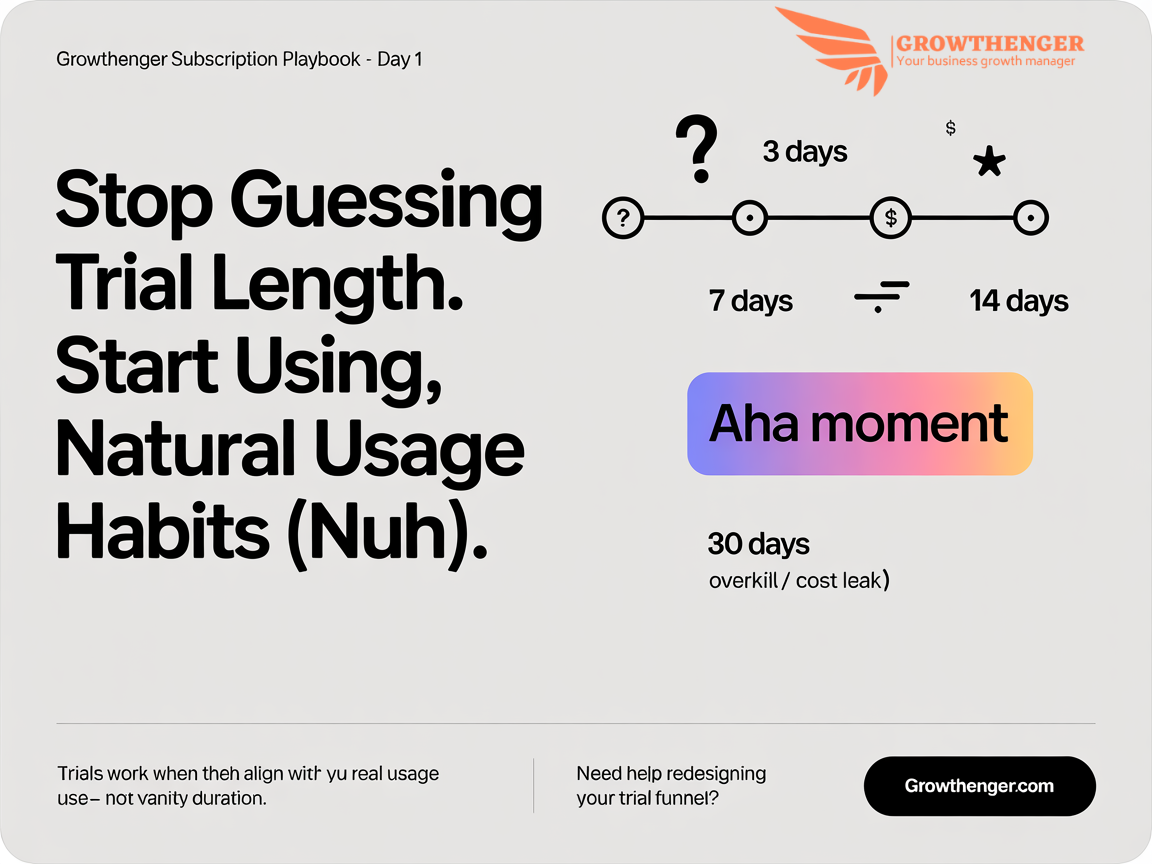
7-day trial?
14-day trial?
30-day trial?
You know exactly where those numbers came from:
Your competitors, not your data.
And that’s the problem.
Most subscription apps don’t have a “free trial strategy”…
They have a free trial copy-paste habit.
Then they wonder:
“Why are people starting trials but not converting?”
“Why does churn spike the moment the trial ends?”
“Why can’t we scale paid marketing profitably?”
Because a trial isn’t a growth hack.
A trial is a system.
A system that sits at the intersection of:
Product (how fast value hits)
Pricing (how believable the value is)
Lifecycle marketing (how well you guide people to the aha moment)
Today, I’m giving you the systems, frameworks, and playbooks the top 1% of apps use — the ones that don’t “hope” trials convert…
They engineer conversions.
PART 1 — Why Most Free Trials Are a Dumpster Fire
Let’s start with a hard truth:
Most apps pick trial lengths the same way college kids pick courses — based on what their friends are doing.
Your competitors use 7 days?
Cool, let’s do 7.
They use 14?
Sure, 14.
No testing.
No data.
No reasoning.
Just copy-paste and pray.
And this creates 3 giant hidden costs:
1. You pay higher CAC for people who never hit the aha moment.
If your trial ends before users “get it,” you’ve basically set money on fire.
Example:
A budgeting app requires 2–4 weeks for users to log enough expenses to see patterns.
A 7-day trial?
Congratulations. You’ve built a churn machine.
2. Your support system gets hammered by wrong-fit users.
They’re not ready.
They’re not committed.
They don’t understand the product.
Support tickets explode.
3. Your churn spikes the moment the trial ends.
Because all you did was delay the churn, not eliminate it.
PART 2 — The Most Important Concept: NUH (Natural Usage Habits)
This is where most founders' brains finally light up.
Forget everything you think you know about trial lengths.
Forget industry averages.
Trial length must come from NUH — not vibes.
NUH = Natural Usage Habits.
The actual pattern of how your users behave once they’re seriously engaged.
It shows:
How long it takes to reach the aha moment
How frequently people naturally use the app
How many sessions are needed to understand the value
How long before value becomes a habit
This is gold.
And almost nobody uses it.
How to discover NUH (this is your money section):
Track these:
1. Time to key event
Examples:
Fitness app → finish first workout plan
Writing app → create 3 documents
Meditation app → complete 7 sessions
Finance app → log expenses for 14–28 days
Productivity app → use it for 5 consecutive workdays
2. Median days between install and aha moment
This tells you EXACTLY how long a new user takes to say:
“Wait…this is actually useful.”
3. The session count pattern
Some apps hit aha in 1 session (Grammarly).
Others take several (YNAB, Headspace, Notion).
Examples of NUH in the Wild (REAL apps)
Meditation apps (Calm, Headspace)
Value kicks in around 7 days of consistent practice.
Shorter trial → user doesn’t feel the benefit.
Longer trial → better but diminishing returns after day 10.
Productivity tools (Notion, Todoist)
People need one full work week before they feel organized.
5–7 days is the sweet spot.
Finance apps (YNAB, Mint, PocketGuard)
Patterns only appear after 2–4 weeks of transactions.
If your trial is < 14–21 days, you’re literally sabotaging conversions.
Fitness apps (Fitbod, Freeletics)
Aha moment = completing a personalized plan.
Usually 7–12 days.
THE RULE (Read this twice): Trial length = Median time to aha moment + 20–30% buffer
That’s it.
This ONE rule can increase trial-to-paid conversions by 20–60%.
Because it grounds your trial in reality, not imagination.
PART 3 — Trial Archetypes (and When You Should Use Each)
There are 3 dominant trial types.
Each works — but only in the right context.
1. Freemium
Free forever basic features
Pay for serious power features
Great for:High-frequency apps (habit apps, utilities)
Competitive niches where people comparison-shop
Examples: Notion, Canva, Duolingo
2. Standard Trial
X days of full access
Then pay or lose access
Great for:Apps with clear early value
Content-rich apps
Examples: Calm (7 days), Grammarly (7 days)
3. Reverse Trial
Everyone starts with premium
After X days, they downgrade
Great for: Apps where premium is the “default experience”Creative tools, workflow tools
Example: Notion uses this brilliantly.
Which should YOU use?
Short answer:
Habit apps → freemium or 7–14 day trial
Business tools → reverse trial
Finance apps → 14–30 day trial
Workflow/organization apps → 10–14 days
Single-utility apps → 3–7 days
PART 4 — Segmentation: The Billion-Dollar Lever
One trial for everyone = guaranteed revenue leak.
Top apps use segmented trials based on behavior.
There are 3 segments that matter:
1. Power Users (hot, engaged, ready to buy)
Signals:
3+ sessions in first 48 hours
Completed key events early
Explored multiple features
Your strategy:
SHORTER trial (they get value fast)
Assertive paywall
“You’re clearly serious about this — unlock full power now” tone
Strong value-based messaging
2. Regular Users (slower to warm up)
Signals:
1–2 sessions in first 48h
Slowly approaching the aha moment
Your strategy:
LONGER trial
Educational in-app guidance
Micro-wins
Softer push to upgrade
3. Returning Users / Win-Back Users
Signals:
Past trial
Past subscription
Coming back after uninstall
Your strategy:
Short, targeted trial
Or access to just ONE important feature
Address their previous objections directly
PART 5 — AI-Driven Experimentation & Predictive LTV
This is where most apps enter “wizard mode.”
Trial performance isn’t just trial length.
It’s a giant multi-variable equation:
Trial length
Pricing
Paywall design
Activation sequence
User segment
Acquisition channel
Country
Seasonality
Trying to optimize this manually is like trying to juggle chainsaws.
Enter predictive LTV systems.
Tools like RevenueCat give you early signals based on:
Session frequency
Key events
Feature depth used
Source/UTM
Region
This lets you test aggressively without waiting 30 days for revenue data.
The Experimentation Loop (your growth engine):
Pick 2–3 trial lengths based on NUH e.g., 7 vs 10 vs 14
Run A/B tests by segment
Use predictive metrics
Roll out winners
Repeat every 60–90 days
This is how compounding growth happens.
Not from hacks.
From systems.
PART 6 — CRM Flows That Print Money
Great trials die from bad lifecycle marketing.
So here’s your CRM blueprint for each segment:
POWER USER TRIAL FLOW
Goal: Get them to subscribe NOW.
Messages:
Early win: “You’ve already done X — people who do this convert 4× more.”
Mid-trial: Feature depth (“Here’s how to get even more value”)
Pre-expiry: “In 10 days, you’ve accomplished X and Y — don’t break your streak.”
Channels:
Push + In-app banners + Email
Strong CTA.
REGULAR USER TRIAL FLOW
Goal: Move them to aha.
Messages:
Low activity? → Nudges, tutorials
Mid-trial → Highlight ONE high-impact feature
Pre-expiry → Lower friction offers (monthly plan)
Channels:
Push + email
Tone: helpful, guiding, “we’ll walk you through it.”
WIN-BACK TRIAL FLOW
Goal: Address the reason they left.
Messages:
“We’ve added X new features since you left.”
“Here’s 7 days of premium access to your favorite feature.”
“Simplified pricing just for returning users.”
Channels:
Email-heavy + smart triggers
Tone: respectful, value-first.
PART 7 — The Metrics That Actually Matter
Let’s kill the vanity metrics.
Trial-to-paid % means NOTHING on its own.
These matter more:
1. Trial start rate (by channel)
Are you attracting the right people?
2. Trial activation rate
Are they hitting key events?
3. Trial completion rate
Did they stay active through the duration?
4. Trial-to-paid conversion rate
Yes, it matters — but with context.
5. PAYBACK PERIOD by trial variant
This tells you how fast marketing becomes profitable.
6. LTV/CAC ratio (by segment + trial length)
This is the CEO metric.
If LTV/CAC improves → scale harder.
PART 8 — How Growthenger Designs High-Conversion Trial Systems
This is the part where I pull back the curtain on how we do this at Growthenger.
Our method is simple, brutal, and effective:
1. Data Audit (NUH, funnel, segments)
We dig into your events, session data, cohorts, and find the REAL usage pattern.
2. Trial Architecture Blueprint
We don’t guess.
We design:
Trial length
Trial type
Segment-based variations
3. In-App + CRM Flow Mapping
We build the end-to-end experience that drives users to the aha moment faster.
4. Experimentation Roadmap
60–90 days of structured tests that compound revenue.
This is where most apps fail — they don’t test systematically.
5. Predictive Metrics Setup
We ensure you can tell winners early — not 30 days later when your budget is already wasted.
FINAL TAKEAWAY (Burn this into your brain)
**Free trials don’t convert because they’re short or long.
They convert because they’re engineered around real user behavior.**
The apps winning today treat their trial system like a product — not a switch in settings.
If you want your subscription revenue to grow month after month…
If you want higher conversions, lower CAC, and a predictable growth engine…
Then you need a trial system built on NUH, segmentation, and ruthless experimentation.
And if you want help building that system →
Growthenger can audit your entire trial funnel and give you a blueprint within 7 days.
(Founders say this audit alone pays for itself within 30 days.)